Shaping: building behaviours one small step at a time
Shaping means rewarding tiny steps toward a goal. Learn how to split a behaviour into steps, when to raise the bar, and how to free-shape your cat's first trick.
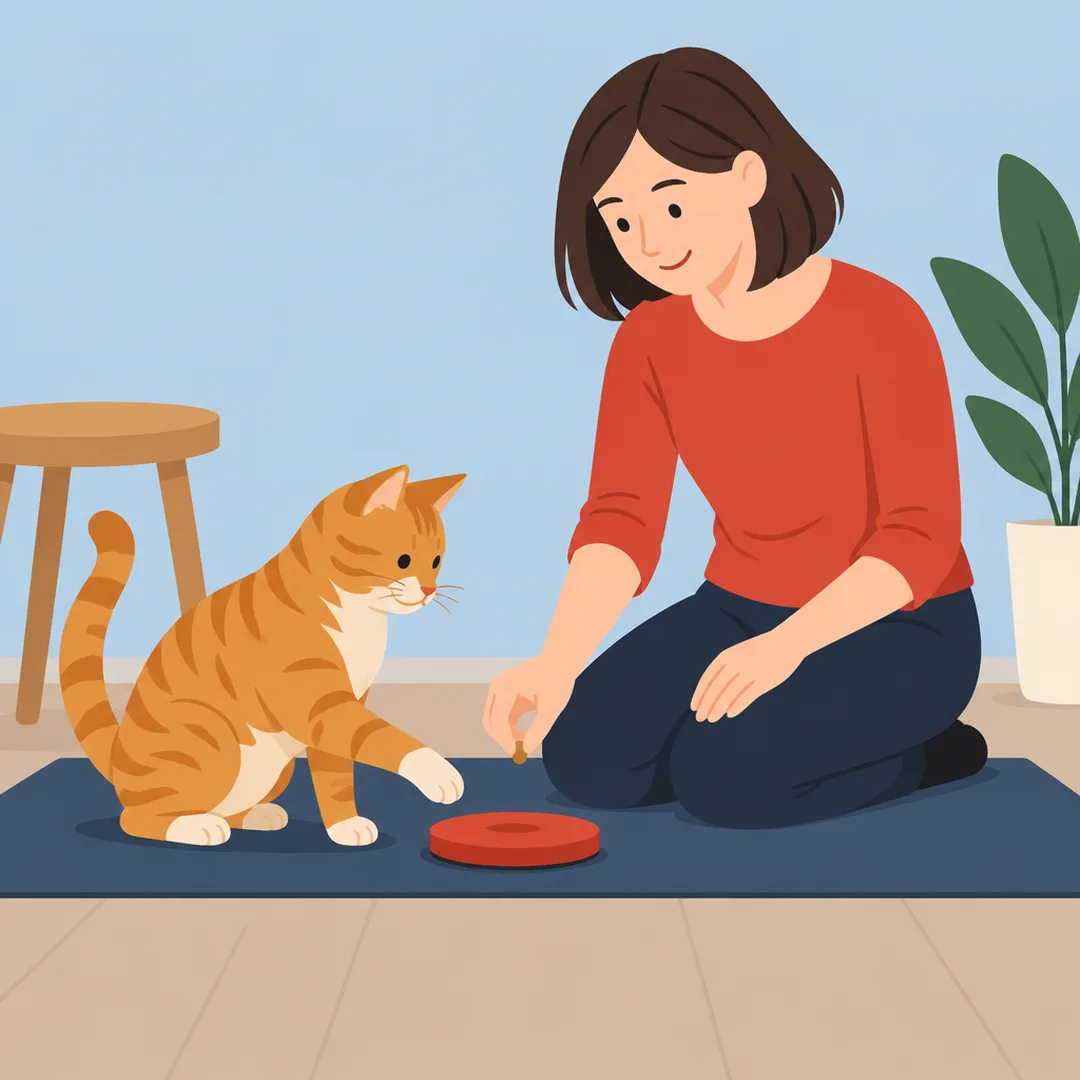
Most behaviours are too big to teach in one go. Shaping breaks a behaviour into tiny steps and rewards each step until the full behaviour appears. It is how animal trainers teach everything from a cat ringing a bell to a dolphin leaping through a hoop, and it is one of the most useful skills you can learn as a trainer.
What shaping is
Shaping means rewarding successive approximations: small changes that get closer and closer to the final goal.
Say you want your cat to sit in a box. You might mark and reward:
- Looking at the box.
- Stepping toward the box.
- Sniffing the box.
- Putting one paw in.
- Two paws in.
- All four paws in.
- Sitting in the box.
Each step is easy, so your cat succeeds often, stays motivated and learns to offer new behaviours.
Shaping versus luring
- Luring uses food or a target to guide your cat into position. It is fast for simple moves like a sit or a spin.
- Shaping waits for the cat to offer something, then rewards it. It is slower at first, but cats learn to think, try things and stay engaged.
Most trainers mix both. You might lure the first step and shape the rest, or shape with a target to help.
Plan before you start
- Define the final behaviour clearly. "Sits inside the box with all four paws for 3 seconds."
- List your steps. Write down 5 to 10 small steps. Have extra in-between steps ready in case your cat gets stuck.
- Set up for success. Quiet room, small treats, a marker your cat knows, a hungry but not starving cat.
- Decide where treats go. Treats placed in position build duration. Treats tossed away reset the cat so it can try again.
When to raise the bar
The thing you are rewarding is called the criterion. Raise it gradually.
- If your cat succeeds 8 out of 10 tries, move to the next step.
- If your cat succeeds 5 to 7 times, stay at this step.
- If your cat succeeds fewer than 5 times, go back a step.
Change one thing at a time. If you are asking for more duration, do not also add distance or distractions. That is the core of the 3 Ds (see that article).
Keep the rate of reward high
In shaping, your cat should be earning a click every few seconds. If 10 or 15 seconds pass with nothing to click, your step is too big. Lower the criterion and click something your cat is already doing that is closer to the goal than what came before. A high rate of reward keeps frustration low.
Free-shaping your first trick: the box game
This classic game teaches your cat to offer behaviours.
- Place an open cardboard box on the floor. Sit nearby with a marker and treats.
- Wait. The moment your cat looks at the box, mark and toss a treat a little away from the box.
- As your cat comes back toward the box, mark any step toward it.
- Next, mark only sniffing or touching the box.
- Then a paw inside. Then two paws. Then all four.
- When your cat jumps in, give a jackpot: three or four treats one after another in the box.
- End the session. Play the game again tomorrow.
Many cats learn "get in the box" in two or three short sessions. Some will start offering other things with the box too, like pushing it or lying in it. That is great: it shows your cat is thinking.
Troubleshooting
- Your cat stares at you or walks off. The step is too hard or the treats are not good enough. Reward something smaller, use a better treat, or try another time.
- Your cat repeats one step and will not move on. You stayed at that step too long. Wait a second or two longer before marking. Cats often vary their behaviour when a reward does not come straight away; mark the variation that is closer to the goal.
- Your cat gets frustrated (tail lashing, swatting, vocalising). Go back to an easy step, give several quick wins and end the session.
- You are unsure what to click. Go back to your written plan. Small and frequent is better than waiting for something big.
Shaping everyday care skills
Shaping is ideal for cooperative care. To teach nail trims you might reward: looking at the clippers, sniffing them, a paw touch, the paw held for one second, the clippers touching a nail, one nail clipped. Spread the steps over days or weeks. Your cat learns that every step predicts good things.
Key points
- Shaping rewards small steps toward a goal until the full behaviour appears.
- Plan your steps in advance, and have smaller in-between steps ready.
- Move up at 8 out of 10, stay at 5 to 7, go back below 5.
- Raise one criterion at a time and keep rewards coming every few seconds.
- Shaping builds a cat who thinks and offers behaviours, which makes every later lesson faster.