Kneading, bunting and other cat quirks
Why cats knead blankets, push their heads into you, chatter at birds, bring you 'gifts' and sniff with their mouths open. The science behind everyday cat oddities.
Cats do a lot of things that look odd to us. Nearly all of them make sense once you know that cats are small hunters whose social life runs on scent. Here is what is going on behind the most common quirks.
Kneading
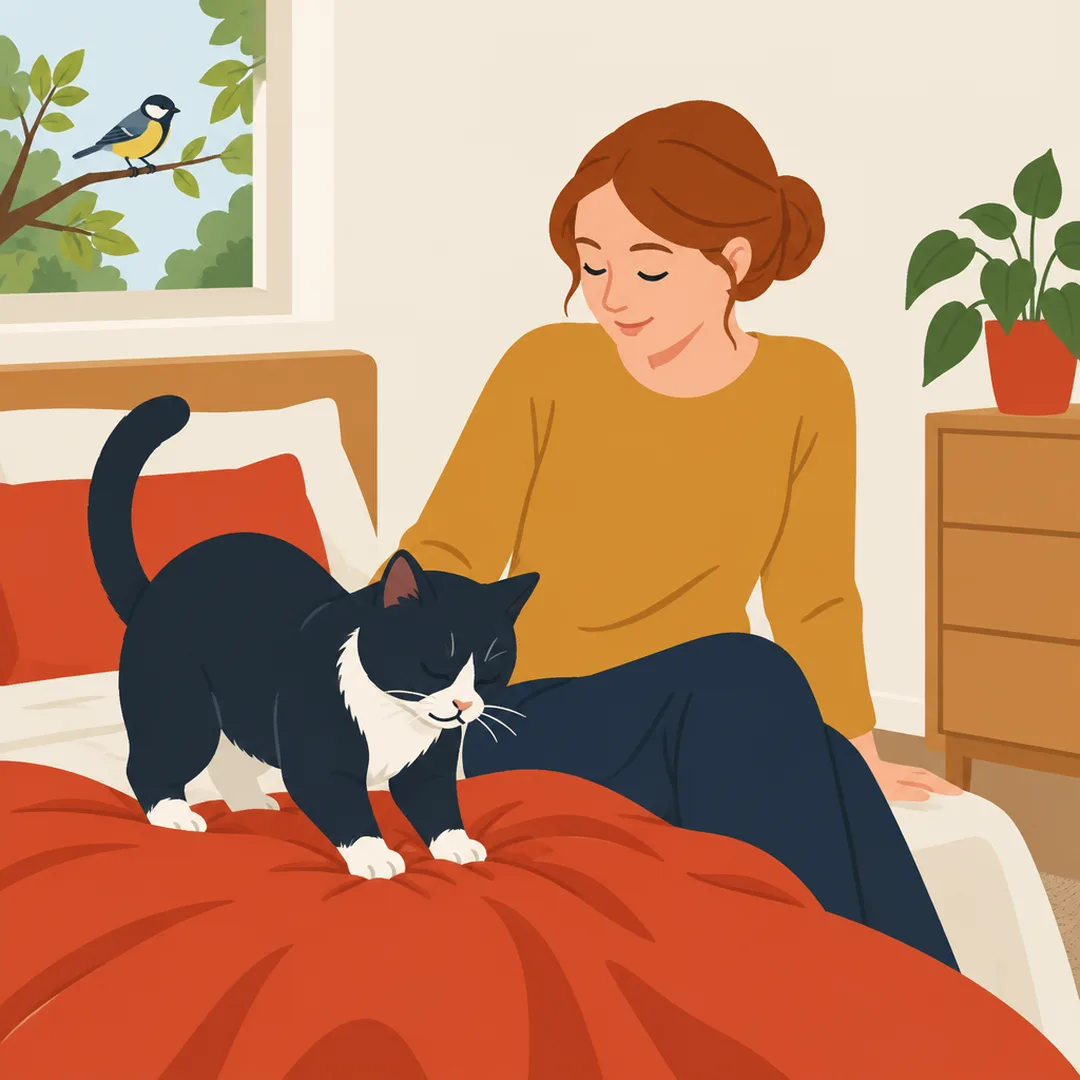
Kneading is the slow, rhythmic push of the front paws, left then right, often on something soft like a blanket or your lap. Some cats purr, drool or suckle on fabric at the same time.
Why: kittens knead their mother's belly to help milk flow. Many cats keep the movement into adulthood as a comfort behaviour linked to feeling safe and content. Paw pads also carry scent glands, so kneading leaves a personal scent mark.
What to do:
- Enjoy it. It is a sign your cat is relaxed with you.
- If claws hurt, put a thick folded blanket on your lap. Do not push the cat away or scold; just gently shift the blanket.
- Keep nails trimmed (see the nail trim article).
- Heavy fabric sucking or chewing, especially of wool, can be a sign of stress or early weaning. If your cat swallows fabric, talk to your vet, as it can cause a blockage.
Bunting and cheek rubbing
Bunting is when your cat pushes its forehead or the side of its face into you, your leg or a chair corner.
Why: cats have scent glands on the cheeks, chin, forehead, lips and the base of the tail. Rubbing deposits facial pheromones that tell the cat "this is familiar and safe". Cats in the same social group rub against each other (allorubbing) to build a shared group scent. When your cat bunts you, you are being included.
What to do:
- Respond with gentle cheek or chin scratches.
- Do not wipe away scent marks on furniture corners unless necessary. They help your cat feel settled. When you move house or redecorate, leaving some old scent in place helps.
The tail-up approach and the "bottom view"
A cat trotting toward you with its tail straight up is greeting you. Turning round and showing you its rear end is part of the same greeting: cats sniff each other's faces and then under the tail. It is polite cat manners, not rudeness.
Chirping and chattering
A cat at the window making fast "ek-ek-ek" sounds with a quivering jaw is chattering. Excitement and frustration both play a part: the cat is wired to hunt and the prey is out of reach.
What to do: after a window session, run a short play session with a feather wand so the cat can stalk, pounce and "catch". Finish with a small treat or meal. That lets the full hunting sequence complete.
Bringing you "gifts"
Outdoor cats may bring in mice or birds. Indoor cats may drop a toy at your feet or in your shoes.
Why: the cat is taking prey to a safe place, which happens to be where you are. There is no good evidence that cats are "teaching" you to hunt.
What to do:
- Never punish. The cat will not connect it to the gift and will only learn to fear you.
- For outdoor cats, daily object play and a meat-rich food have both been shown to reduce the number of animals brought home. Brightly coloured collar covers also reduce bird catches in some studies.
- For indoor cats, a toy at your feet is often an invitation to play. Say yes when you can.
The open-mouth sniff
Sometimes a cat sniffs something, then freezes with the mouth slightly open and upper lip raised, looking disgusted. This is the flehmen response.
Why: cats have a second scent organ, the vomeronasal (or Jacobson's) organ, in the roof of the mouth. Opening the mouth draws scent molecules, especially pheromones, toward it. Cats often do this after sniffing urine marks, other cats or your shoes after a visit somewhere new.
Sitting in boxes and on your keyboard
Boxes give cats a hidden, enclosed place with walls on all sides, which feels safe. A study on shelter cats found that cats given a hiding box adapted to the shelter faster and showed lower stress scores than those without one.
Your laptop is warm, central and the thing you are paying attention to. Give your cat a warm bed or a box on the desk next to you, and reward them for using it.
Knocking things off tables
Batting objects tests whether they move, which is exactly how a cat checks if prey is alive. It also gets your attention fast. Give your cat more object play: rolling balls, toys on strings, puzzle feeders. Avoid reacting strongly when something falls, or the cat may learn it is a reliable way to make you jump up.
Key points
- Kneading is a relaxed, comforting behaviour from kittenhood; protect your lap with a blanket instead of pushing your cat away.
- Bunting and cheek rubbing leave scent from facial glands and mark you as family.
- Chattering at birds is hunting frustration; follow it with a wand-toy hunt.
- The open-mouth "flehmen" face is your cat using a second scent organ.
- Never punish quirks; redirect them to something that meets the same need.
Sources
- International Cat Care: Cat communication and scent
- Cats Protection: Why do cats knead?
- Cornell Feline Health Center: Feline behavior problems
- AAFP/ISFM Feline Environmental Needs Guidelines (scent and the fifth pillar)
- Cecchetti et al. (2021) High meat food and object play reduce predation by domestic cats. Current Biology
- Vinke et al. (2014) Will a hiding box provide stress reduction for shelter cats? Applied Animal Behaviour Science
- Cafazzo & Natoli (2009) The social function of tail up in the domestic cat