Puzzle ladder for cats: how to play
A four-step plan from very easy to very hard food puzzles. Move up only when your cat finishes the current level with ease.
- Time
- 15 min
- Energy
- Low
- Space
- Small room

You'll need
- one puzzle at each level (for example: open muffin tin, treat ball, tube wall or bottle, multi-step puzzle board)
- measured kibble
Set up
Set aside the day's kibble. Food puzzles come in stationary types (your cat paws food out while the puzzle stays put) and mobile types (your cat rolls the puzzle). Pick one of each per level if you can.
How to play
Level 1, very easy: food visible and loose. Open muffin tin, egg carton, wide-open treat ball. Graduate when your cat empties it in a few minutes, 3 days in a row.
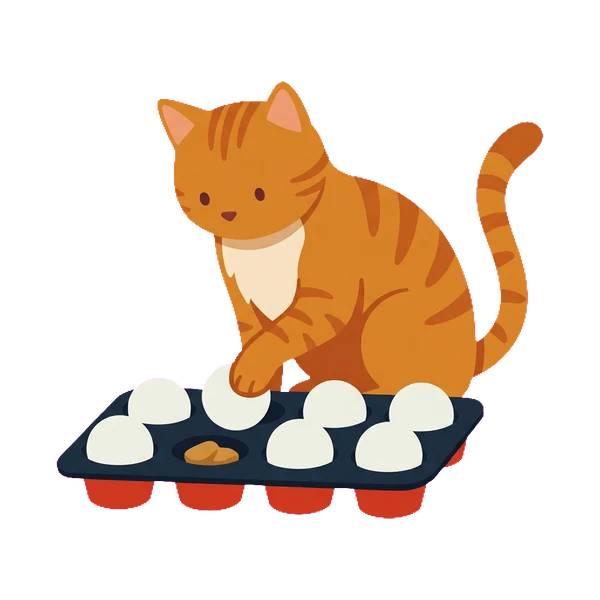
Level 2, easy: food visible but covered. Balls in the muffin tin, tube pyramid, treat ball with medium holes.
Level 3, hard: food hidden and needs reaching or rolling. Deep tube wall, bottle with small holes, sushi rolls packed tight.
Level 4, very hard: multi-step puzzles with sliders, lids or drawers that must be moved in order.
At each new level, start with half the portion in the puzzle and half in a bowl. Shift more into the puzzle over a week.
If your cat struggles, drop back a level for a few days. Mix levels through the week to keep it interesting.
House rules
- Move up only after 3 easy days.
- Never let a puzzle stand between your cat and enough food.
- Weigh weekly.
- Make it easier
- Stay at levels 1 and 2. Many cats, especially seniors and kittens, are happiest there.
- Make it harder
- Combine two puzzles in a row, or hide the level-4 puzzle in another room.
Signs it's having fun
Approaching puzzles eagerly, working steadily, finishing without crying for help.
Stop if you see
Leaving food behind, crying at the bowl, weight loss, or giving up quickly.
Safety
 Safety
- A cat that eats too little for a day or more needs a vet check. Do not wait it out.
- Weigh your cat weekly while changing feeding.
- Wash puzzles regularly.
Sources
- Food puzzles for cats: feeding for physical and emotional wellbeing (Dantas et al., summary)
- Study finds nearly a third of cat owners use food puzzles (UC Davis)
Written from these sources and checked against vet and trainer guidance. General guidance, not veterinary advice.
Game · 15 min
Expert puzzle board for cats: how to play
A multi-step puzzle with sliders, lifting lids and spinning discs. For confident cats that breeze through everything else.
Game · 10 min
Treat treasure hunt for cats: how to play
Hide treats or kibble around a room, then around the home, and let your cat sniff them out.
Game · 10 min
Muffin-tin puzzle for cats: how to play
Kibble in a muffin tin, cups covered with balls. Your cat scoops the balls out to find the food.




